An unseen ruler defines with geometry An unrulable expanse of geography An aerial photographer over-exposed To the cartologist′s 2D images knows The areas where the water flowed So petrified, the landscape grows Straining eyes try to understand The works, incessantly in hand The carving and the paring of the land The quarter square, the graph divides Beneath the rule, a country hides
Interrupting my train of thought Lines of longitude and latitude Define and refine my altitude
The curtain's undrawn Harness fitted, no escape Common and peaceful, duck, flat, lowland Landscape, canal, canard, water coloured Crystal palaces for floral kings A well-known waving span of wings Witness the sinking of the sun A deep breath of submission has begun
Interrupting my train of thought Lines of longitude and latitude Define and refine my altitude
This special holiday blog, featuring several versions of Wire’s evergreen classic “Map Ref. 41°N 93°W,” is dedicated to my old 1990s Russia comrade L.J., who lives a mere seventy or so miles from the map reference in question and once upon a (better) time invited me to screen the world’s greatest mockumentary, First on the Moon, at the fab Mars Cafe in Des Moines. ||||| TRR
I reach out to you in anger and pain concerning the arrest of my sister and colleague Daria Egereva and the new, large-scale crackdown against representatives of Russia’s Indigenous Peoples. Phrases like “isolated incident” or “local overreach” do not describe what is happening today. This is a deliberate, targeted state policy of intimidating, suppressing, and criminalizing Indigenous leaders, of destroying the will of our peoples.
I speak about this not only as a member of the UN Permanent Forum on Indigenous Issues but also as someone who has fallen victim to this crackdown myself. On 17 December 2025, my home in the village of Lovozero was searched. Security forces broke into my personal space and confiscated computer equipment, communication devices, and documents. Similar searches and interrogations took place in the homes of other Indigenous minority activists throughout Russia. It was a planned, well-coordinated campaign of intimidation.
This is not a new reality for us. Back in 2014, I and other representatives of Indigenous Peoples were persecuted by the security forces for trying to convey the truth about the circumstances of Indigenous Peoples in Russia to the international community when we were prevented from leaving the country to attend a UN conference. Today, this practice continues in a much more brutal form, and it has been happening across the country. Crackdowns against the people involved in the events in Baymak, criminal cases against Erzya activists, and the detention of social movement activists in the Altai Republic are just recent examples of how the state has been trying to destroy the independent voice of the peoples of Russia.
Indigenous human rights activists have been labeled “extremists” and “terrorists” simply because they have used peaceful means to defend their peoples’ rights to their traditional lifestyles, cultures, languages, and basic human dignity. This is punishment for those who are not afraid to speak the truth openly, including outside their country, at the UN and other human rights forums.
Particularly outrageous is the fact that the Russian authorities accuse activists of terrorism, a crime for which Russia today imposes monstrous sentences of fifteen to twenty years in prison on people who have not committed violent acts and have never called for violence. These sentences are not intended to “combat terrorism” but to intimidate. The Russian authorities have laid their hands on those who have led a traditional way of life for centuries, herding reindeer, fishing, hunting, and foraging for wild plants on their own land, thus preserving their knowledge of Nature bit by bit.
We must not mince words: this is not a fight against terrorism, it is political vengeance. It is direct punishment by the state for the fact that representatives of Indigenous Peoples dare to appeal to the UN, speak out about violations of their rights, take part in the work of international bodies, and tell the truth about what is happening in Russia. The Russian authorities are deliberately criminalizing the very idea of cooperating with the United Nations.
There is virtually no room left in today’s Russia for free and independent opinion. Any criticism, any dissent, any independent social activism is harshly squashed. It is particularly cynical that the blow is being dealt to the most vulnerable—to the Indigenous Peoples of Siberia and the Arctic, who are socially disadvantaged, dwell in remote settlements amid harsh natural conditions, have no political clout, and are invisible to “mainstream society.” Our peoples cannot defend their rights except through international law, and nd that is precisely why we are being punished today.
I would particularly like to emphasize the Russian state’s profound hypocrisy. While formally declaring its commitment to protecting the rights of Indigenous Peoples, it has been systematically destroying independent Indigenous Peoples’ organizations for many years by persecuting their leaders and using state-controlled structures such as RAIPON and councils attached to regional governments as puppets on the international stage. These puppets do not represent the real interests of Indigenous Peoples, serving only as a front for repressive policies and a means of propagandizing the “happy lives” of our peoples in Russia.
What is particularly cynical about the current developments is that just recently, in November 2025, Vladimir Putin decreed April thirtieth “Russia’s Indigenous Minorities Day” and September eighth “Languages of the Peoples of Russia Day,” and declared 2026 “Peoples of Russia Unity Year.” While the Kremlin announces celebrations and talks about “supporting” our peoples, the searches, interrogations, and arrests of their leaders continue at the local level.
I appeal to states, UN bodies, special procedures, international human rights mechanisms, international Indigenous peoples’ networks, and civil society organizations. A clear, principled, and public position is what is needed today. We must demand the immediate release of Daria Yegereva and the other activists who have been detained, as well as the immediate cessation of all forms of repression, criminal prosecution, and pressure against representatives of the Indigenous Peoples in Russia. We must demand an end to criminal prosecution for engaging in peaceful human rights work and cooperating with the United Nations.
For my part, I intend to raise this issue at the UN Permanent Forum on Indigenous Issues and other UN bodies. I will seek international condemnation of what is happening, protection for those who have been illegally persecuted, and attention to the gross and systematic violations of the rights of Indigenous Peoples in Russia.
In conclusion, I would like to address Daria personally.
Dasha, sister, you are not alone. Your courage and your voice have struck fear in those who are used to acting in silence and with impunity. We are with you, and we speak out and demand justice! The solidarity of Indigenous Peoples is stronger than prisons and political crackdowns. We are in this together!
—Valentina Sovkina, member of the United Nations Permanent Forum on Indigenous Issues (UNPFII)
The International Indigenous Peoples Forum on Climate Change (IIPFCC) condemns the wrongful arrest of IIPFCC Co-Chair, Daria Egereva, and demands her immediate release.
Daria Egereva speaking into a conference microphone. Photo courtesy of L&DC
Daria Egereva is a Selkup Indigenous person of Russia and a long-time member of the Centre for Support of Indigenous Peoples of the North (CSIPN). After many years of valued involvement in the Indigenous Peoples’ Caucus at the UNFCCC, she was elected Co-Chair of the IIPFCC in 2023.
On December 17th, Russian authorities searched Ms. Egereva’s home, confiscated her digital devices, and arrested her under accusation of participating in a ‘terrorist organisation’ in direct retaliation for her Indigenous rights advocacy, including her leadership of accredited Indigenous Peoples at last month’s COP30 United Nations Climate Conference in Belém, Brazil.
A court hearing held on December 18th determined that Ms. Egereva will continue to be detained for two months, pending a further investigation into her case. The accusation carries a potential prison sentence of 10 to 20 years.
“For the last three COPs, Daria has been foundational to the effectiveness of the IIPFCC. Not only a principled leader, she is warm and generous to friends and colleagues alike. Her arrest is completely unfounded and our whole caucus is very concerned for her,” says Dr Graeme Reed, former IIPFCC Co-Chair
Ms. Egereva’s arrest was part of a coordinated operation by the Federal Security Service of the Russian Federation (FSB), which targeted at least seventeen Indigenous leaders across Russia whose homes were raided, electronic devices confiscated, and who were accused under spurious terrorism-related charges.
This targeted attack on Indigenous leaders represents direct retaliation for their participation in United Nations processes, and sets a dangerous precedent for the treatment of Indigenous Peoples who participate in global human rights and climate change meetings.
“These reprisals are part of a broader pattern of repression affecting Indigenous Peoples across the globe, and are an unacceptable attack on the right of Indigenous Peoples to engage in the global human rights and climate change processes,” says Sineia Do Vale, Ms. Egereva’s fellow Co-Chair, IIPFCC
The IIPFCC is deeply concerned for Ms. Egereva, and calls upon all state parties to the UNFCCC, and all allies of Indigenous Peoples to mobilise in solidarity to:
1. Publicly and privately call for Ms. Daria Egereva’s immediate release and the dropping of all charges against her, which constitute an illegal retaliation for her legitimate and peaceful participation in COP30 and other UN processes.
2. Acknowledge and register this complaint as a case of intimidation and reprisal connected to participation in UNFCCC processes under the Code of Conduct for UNFCCC Events, and keep the IIPFCC informed of steps taken.
3. Raise this case without delay with the Government of the Russian Federation through appropriate diplomatic channels, stressing that criminalizing a UNFCCC Indigenous Co-Chair as a ‘terrorist’ is incompatible with the UNFCCC Code of Conduct and with Human Rights Council resolutions/determinations.
“This is not a prosecution of terrorism. It is a defiance of the Human Rights Council’s findings and an attempt to use domestic courts to override international human rights determinations and silence Indigenous Peoples.”
– Joan Carling, Executive Director of International Peoples Rights International
“Around the world, Indigenous leaders face criminalization, persecution, and judicial harassment mechanisms designed to silence our voices, dismantle our institutions, and weaken our collective efforts to defend our rights and territories. These targeted practices constitute serious violations of human rights and international law.”
– Hindou Oumarou Ibrahim, Vice Chair of the UN Permanent Forum on Indigenous Issues and former Co-Chair of the IIPFCC
The IIPFCC firmly rejects this unjust intimidation and detention. We stand with Daria, the other Indigenous leaders who have been detained, their families, and all Indigenous defenders whose safety, dignity, and freedom are under threat.
About the IIPFCC: The International Indigenous Peoples Forum on Climate Change (IIPFCC) was established in 2008 as the caucus for Indigenous Peoples participating in the UNFCCC processes. It represents the collective positions of Indigenous Peoples from all seven socio-cultural regions.
“Try me for treason. I betrayed your deranged state”, the Russian anti-war protester Andrei Trofimov told the Second Western District Military Court in May.
In 2023, Trofimov was sentenced to ten years’ imprisonment, for opposing Russia’s war in Ukraine in social media posts, and trying to join the Free Russia Legion that fights on Ukraine’s side. At that hearing, Trofimov said he hoped for Ukraine’s victory, and called president Putin “a dickhead”.
On the basis of that statement alone, he was further accused of “justifying terrorism” and defaming the Russian army. For those “crimes”, the judge at the hearing in May this year, Vadim Krasnov, added three years to Trofimov’s sentence.
Before sentencing, Trofimov told the court that he had not justified terrorism, but supported the Ukrainian armed forces’ legitimate military actions against aggression, and had not defamed the Russian army whose actions were unconstitutional and illegal. He told the court that he considered himself guilty of a much more serious crime: treason – taking the enemy’s side in war.
And there will be another chance to hear these powerful readings in London – on Thursday 5 February 2026, 6:30 p.m., at Birkbeck College. Here are the details.
You can order copies of Voices Against Putin’s War, or download a free pdf, here.
We published the book against the background of repeated claims that a peace agreement is about to be signed between Russia and Ukraine. These are louder than ever after this week’s talks in Berlin. At the time of writing this, it is not clear to me that the Kremlin is really interested in stopping the war, or what the “security guarantees” being offered to Ukraine actually mean.
I would recommend following the excellent arguments made about the peace process by Oleksandr Kyselov (most recently here, also here and here), Hanna Perekhoda (who writes on Facebook here), and other Ukrainian socialist writers.
If you want to know why the 20% of Donbas that Ukraine still controls matters so much, this comment by the Institute for the Study of War is worth reading. This speech by Valery Zaluzhny helps us understand what the Ukrainian political elite thinks.
Whatever the outcome of the talks now in progress, if any, the defence of victims of Russia’s military occupation of Ukrainian territory, and domestic political repression, will remain a central issue for our movement, right across Europe.
Tajikistan has condemned what it called an “ethnic hatred” attack in Russia after a 10-year-old boy from a Tajik family was stabbed to death at a school near Moscow, in a rare public rebuke aimed at a key partner for labor migration and security ties. The killing happened on December 16 in the village of Gorki-2 in the Odintsovo district of the Moscow region, according to Russia’s Investigative Committee, which said a minor attacked people at an educational institution, killing one child and injuring a school security guard.
A video of the attack circulated on Russian social media after the incident. According to reporting by Asia-Plus, footage published by the Telegram channel Mash shows the teenage assailant approaching a group of students while holding a knife and asking them about their nationality. The video then shows a school security guard attempting to intervene before the attacker sprays him with pepper spray and stabs him. The assailant subsequently turns the knife on the children, fatally wounding the 10-year-old boy.
A statement released by Tajikistan’s interior ministry said it feared the case could “serve as a pretext for incitement and provocation by certain radical nationalist groups to commit similar crimes.” Tajikistan’s response also drew attention after the foreign ministry said the attack was “motivated by ethnic hatred.” Dushanbe subsequently summoned the Russian ambassador to protest the attack, handing him a missive “demanding that Russia conduct an immediate, objective, and impartial investigation into this tragic incident.”
The condemnation is particularly notable as Tajikistan rarely issues public criticism of Russia, which remains its main destination for migrant labor and a key security partner.
According to Russian media, the attacker, who has admitted their guilt, subscribed to neo-Nazi channels and had sent his classmates a racist manifesto entitled “My Rage,” in which he expressed hostility toward Jews, Muslims, anti-fascists, and liberals, a few days before the incident.
Tajik migrants form one of the largest foreign labor communities in Russia and across Central Asia. Millions of Tajik citizens work abroad each year, most of them in Russia, sending remittances that are a critical source of income for families at home. According to the World Bank, remittances account for roughly half of Tajikistan’s gross domestic product in some years, making labor migration a cornerstone of the country’s economy. Many Tajik migrants work in construction, services, and transport, often in precarious conditions and with limited legal protections. The killing comes as Central Asian migrants in Russia face growing pressure to enlist in the war in Ukraine, with coercion through detention, deportation threats, and promises of legal status having been reported.
The killing has also renewed scrutiny of rising xenophobia in Russia, particularly toward migrants from Central Asia. The Times of Central Asia has previously reported an increase in hate speech, harassment, and violent attacks targeting migrants, especially following major security incidents. Human Rights Watch has warned that Central Asian migrants in Russia face growing discrimination, arbitrary police checks, and racially motivated abuse, trends that have intensified in recent years amid heightened nationalist rhetoric.
It’s curious. I looked through some of the [social media] pages of Russia’s [most prominent] political émigrés—[Ilya] Yashin, [Vladimir] Kara-Murza, [Ekaterina] Schulmann, [Leonid] Volkov, [Elena] Lukyanova, [Dmitry] Bykov, [Marat] Gelman, [Boris] Zimin, [Boris] Akunin—but I couldn’t find a word about the violent death of a Tajik boy in a school near Moscow. They have expressed no sympathy, voiced no criticism of racism and xenophobia. It seemingly should be their direct obligation to speak out on this issue. But for some reason, mum’s the word. I also looked at the Telegram channels of the leading official anthropologists, and there is a mysterious muteness among them too. Surely it is their professional duty not to remain silent on such a matter. They even published a book called Tajiks and themselves speak everywhere of interethnic harmony. But in this case, it’s as if they’ve dummied up.
Source: S.A. (Facebook), 18 December 2025. Translated by the Russian Reader
As FB is reminding, there were times I believed I could protect my non-Slavic looking friends, lovers, relatives, foreign students and migrant workers from the nazis marching in the streets, from the nazis working as policemen, from the general xenophobia and unsensibility by magic tricks of art.
Thomas Campbell just translated our migrant labor board game Russia – The Land of Opportunity!!!
Russia – The Land of Opportunity board game is a means of talking about the possible ways that the destinies of the millions of immigrants who come annually to the Russian Federation from the former Soviet Central Asian republics to earn money play out.
Our goal is to give players the chance to live in the shoes of a foreign worker, to feel all the risks and opportunities, to understand the play between luck and personal responsibility, and thus answer the accusatory questions often addressed to immigrants – for example, “Why do they work illegally? Why do they agree to such conditions?”
On the other hand, only by describing the labyrinth of rules, deceptions, bureaucratic obstacles and traps that constitute immigration in today’s Russia can we get an overall picture of how one can operate within this scheme and what in it needs to be changed. We would like most of all for this game to become a historical document.
Life for migrant workers is Russia is becoming increasingly difficult after stringent new controls introduced over the past year. These include a registry of “illegal” migrants, restrictions on enrolling migrant children in schools, new police powers to deport people without a court order, and a compulsory app for all new migrants in Moscow and the surrounding region to track their movements.
Working in Russia was already less appealing because of the war in Ukraine and the weakening rouble. Now, with these new restrictions, a growing number of young people from Central Asia are starting to look elsewhere — including to countries in Europe — in search of better opportunities.
Dreaming of Europe in Moscow
Like 89% of young Kyrgyzstanis, 25-year-old Bilal* had always dreamed of working abroad.
Young people in Kyrgyzstan grow up in an environment where leaving the country to find work is common, widespread, economically essential, and socially accepted — and where the domestic economy still cannot offer comparable opportunities.
The average monthly salary in the country is about 42,000 soms (around $480), while in Russia, for example, wages in manufacturing can reach 150,000 rubles (nearly $2,000). Unlike most of his peers, Bilal never planned to work in Russia. “Because many of our people face racism there,” he explains.
Europe was his dream, but without connections getting a job offer from an EU employer seemed nearly impossible. So Bilal turned to “intermediaries” — fellow Kyrgyzstanis who had established ties with European companies that were constantly seeking workers. They advised him to travel to St. Petersburg, where, they said, it would be easier to prepare the paperwork and apply for a visa.
But it was the height of the COVID-19 pandemic. Many Schengen countries had stopped issuing visas and temporarily shuttered their consulates. Bilal didn’t want to return home empty-handed, so he decided to stay in Russia — “not by choice,” as he puts it.
“At first I worked illegally at a ski resort. Mostly we chopped firewood and cleared snow around the cabins. They paid us in cash,” he says.
Two months later, Bilal moved to Moscow and obtained a patent — the work permit that allows citizens of visa-free countries to be legally employed in Russia. He found a job as a courier for Yandex.
Bilal speaks excellent Russian — something he says explains why, unlike many of his friends, he didn’t encounter xenophobia all that often. But conflicts still happened. “You’d run into people who’d say, ‘Migrants, coming here in droves…’ Especially when a customer had put down the wrong address and the delivery got messed up — somehow it was always the migrant’s fault.”
Bilal left Russia two months before the full-scale invasion of Ukraine. “Back then it wasn’t like it is now,” he recalls. “Yes, the police would stop you on the street, but they’d take some money and let you go. Now my friends talk about Amina (a Russian mobile app for monitoring migrants), about police rounding people up, and about being sent to the war.”
He decided to set his sights on Europe instead.
Watched and bullied
In Russia, the path to legal employment for migrant workers runs through a processing centre known as Sakharovo — located about 60 kilometres from Moscow and notorious for its massive queues, where people often wait for hours. The perimeter is guarded by armed security forces, and inside migrants undergo procedures such as blood and urine tests to screen for “socially significant diseases”. Those who manage to obtain their documents can work legally, but that doesn’t protect them from future problems.
Russians often refuse to rent apartments to migrants. Schools and kindergartens decline to accept migrant children, citing “lack of space,” while the adults themselves face workplace “raids” or frequent “document checks” on the street or on public transport. Even Russia’s war in Ukraine has become a tool for pressuring them: many migrants are pushed to join the military in exchange for various “bonuses,” such as fast-tracked citizenship.
After the attack on Crocus City Hall — which authorities say was carried out by four Tajik citizens —the security services launched large-scale raids. Tajikistan’s government, fearing a surge in xenophobic incidents, even advised its citizens not to leave their homes.
Lawmakers soon joined in. Over the past year, they have restricted the ability to obtain residency through marriage, granted the Interior Ministry the power to deport migrants without a court ruling, required migrant children to pass a Russian-language exam before being admitted to school, and created the Registry of Monitored Persons — a database of foreign nationals who supposedly lack legal grounds to stay in Russia. There are already known cases of people being added to the list by mistake, and effectively losing the right to move freely around the country after their bank accounts were frozen, and their driving permits revoked.
Officials have justified all these measures as necessary to fight illegal migration and prevent crime. In July, the Interior Ministry reported a rise in crimes committed by migrants, but migrants still make up only a small fraction of overall crime statistics. A study by the “To Be Exact” project found that adult Russian men are statistically more likely to commit crimes than migrant workers.
On September 1, a new pilot project went into effect: migrants from Uzbekistan, Tajikistan, Kyrgyzstan, Armenia, Kazakhstan, Georgia, Azerbaijan, Moldova, and Ukraine who are living in Moscow or the Moscow region must install a mobile app called “Amina.” Authorities openly acknowledge that the app’s main purpose is to continuously track users’ locations.
The app that doesn’t work
If a phone fails to transmit location data to Amina for more than three working days, the participant is automatically removed from the system. If the migrant cannot fix the issue quickly, they risk being added to the “monitored persons” registry — which can lead to frozen bank accounts, job loss, or even expulsion from university.
Imran, a 27-year-old Tajik citizen, is worried: “Location services on my phone are on, and Amina shows that everything is being transmitted, but several times a day I get notifications saying the app isn’t receiving my location. The app works terribly. And I have no idea what consequences this could have for me.”
Users report constant problems with Amina. Some can’t get past the first screen; others say the app won’t accept their photo; still others receive alerts that their data failed verification. But the most common issues are related to location tracking.
In comments on RuStore (Russia’s internal apps store), representatives of the developer respond that “specialists are constantly working to improve the app’s stability” and advise users to contact technical support. But migrants complain about waiting on the line for hours.
Anton Ignatov, the director of the Sakharovo centre, claims the programme will improve public safety and help “prevent violations by unscrupulous individuals”. He cites situations in which migrants buy a work patent — a permit to work — for a short period and then disappear “into the shadows,” “vanishing somewhere in the industrial zones of Moscow and the region”.
Such cases do happen, and the most obvious reason is money. Since January 1, the monthly payment for a work patent in Moscow and the Moscow region has been 8,900 roubles (about $115). For many migrants working in low-paid jobs — for example, in construction or warehouse work — this is a significant share of their income, pushing some into the informal economy.
Another factor is wage delays in the sectors where migrants from Central Asian countries most often work. Mukhammadjon from Uzbekistan, works on a construction site outside Moscow, hasn’t been paid in two and a half months. A month ago, he stopped paying for his patent — simply because he had no money left. He sees no tools to defend himself.
Employers, meanwhile, benefit from hiring such vulnerable workers: they can avoid paying social contributions, hand out wages in cash, and rely on employees who are willing to work overtime for low pay.
Getting a job is becoming harder
Kudaibergen, 32, from Kyrgyzstan, worked at a warehouse on the outskirts of Moscow — “to support my family”, he says. His employer provided hostel-style housing for migrant warehouse workers.
“OMON came to our building. They treated us like they were arresting dangerous terrorists. They showed up with batons and tasers, as if storming the place. They drove us all outside. We stood by the door with our hands behind our backs for about two hours while they checked everyone’s documents,” he recalls. “Some guys didn’t understand Russian well — it was very hard for them. If they didn’t understand something, they were beaten. […] Thank God, my documents were in order.”
Russian authorities typically insist that such inspections are carried out strictly within the law and that no unlawful actions are taken against migrants. As evidence, the Interior Ministry points out that migrants rarely file complaints with the police afterward.
As the new year approached — 2025 — the checks intensified, Kudaibergen says. Because of all the new rules and the overall treatment of migrants, he realized that working in Russia had become too difficult, so he returned home.
“But I still have to provide for my family,” he adds. “I’m thinking about Europe now. I ask friends and acquaintances how to leave. But I don’t know if it will work out. They say getting a visa is very hard.”
Gulnura, 35, a mother of three, had lived in Russia with her husband for more than ten years. In the spring of 2025, she flew with her children to her native Kyrgyzstan for a short break. Only after arriving did she learn about the new requirement obliging migrant children to pass a Russian-language exam in order to enroll in school. Her children speak Russian fluently, yet even before the rule change they hadn’t been admitted — schools said there were “no available places”.
“We originally planned to return to Moscow. But my friends who are still there complain that they can’t get their kids into school,” Gulnura says. “One friend has been collecting documents since April, but the school won’t accept them. Another managed to get her child to the test, but after the exam they sent a rejection: ‘Your child doesn’t know Russian well enough.’ Her daughter was born and raised in Moscow, speaks Russian fluently, went to kindergarten and prep classes, reads and writes.”
“Requiring language proficiency provides a pretext for an already widespread practice of arbitrarily refusing to admit migrant children to schools across Russia,” says Sainat Sultanaliyeva of Human Rights Watch. “By depriving migrant children of access to education, Russian authorities are effectively taking away the life opportunities schooling provides. Banning them from school undermines long-term social integration, increases the risk of harmful child labour, and heightens the danger of early marriage.”
Gulnura decided not to return to Russia with her children. “My husband is still in Moscow for now. He’ll come when everything is ready here, when he has work. But we — me and the kids — we’ve come back for good. It’s become impossible to live there.”
A chance to get into Europe
Despite numerous accounts of migrants becoming disillusioned with Russia, it’s impossible to say definitively whether labour migration has decreased in recent years: the available statistics are fragmented, and data from different government agencies often contradict one another.
The picture is further complicated by the Interior Ministry’s decision to stop publishing key data, as well as several changes to the methodology of migration accounting, which make year-to-year comparisons unreliable.
In 2024, researchers at the Higher School of Economics concluded that labour migration to Russia had fallen to its lowest level in a decade.
Since then, the number of entries into the country has grown, but the average annual presence of legal labour migrants has remained stable at around 3–3.5 million — noticeably lower than in previous years.
Rossiyskaya Gazetawrites that foreign workers are less willing to come to Russia for two reasons: tougher migration policies and declining incomes. With the rouble’s depreciation, earnings in dollar terms have fallen by roughly a third.
Yet Russia still remains the most popular destination for labour migrants from nearly all Central Asian countries.
In second place for migrants from Uzbekistan, Tajikistan, and Kyrgyzstan is Kazakhstan, where most work in construction, wholesale and retail trade, and various service industries.
Third is Turkey, where Central Asian migrants are employed in manufacturing — especially textiles and clothing — as well as construction, hospitality, and seasonal agriculture.
South Korea recruits migrant labor for factories, agriculture, construction, and the fishing and seafood-processing industries.
But for many — like Bilal, who left Russia behind — the dream is still to secure a job offer in Europe. In the end, he managed to do so through the same intermediaries he had relied on earlier, paying them $2,000, he says. They helped arrange an invitation from a logistics company.
“If you don’t have work experience in Europe, it’s hard at first to get a job with a good trucking company. There are bad employers who take advantage of newcomers not knowing their rights. They might underpay you or force you to work overtime. At the same time, the police keep a very close eye on work-and-rest rules and can fine you, so nobody wants to break the law. By law, if your driving time is up, you have to stop and rest,” Bilal says, recalling his first job at a Slovak company.
After gaining some experience, he moved to another company, where he now earns around €2,500 a month.
According to the International Road Transport Union (IRU), more than half of European transport companies cannot expand their business because of a shortage of qualified drivers. Across the EU, Norway, and the UK, more than 233,000 truck drivers are currently required. The crisis is deepened by the fact that the profession is aging rapidly, and young people are not drawn to it, despite decent pay.
Ukrainian citizens once made up a significant share of long-haul drivers in the EU, but because of the war many had to return home for military service. In addition, some European employers terminated contracts with Russian and Belarusian citizens (or their visas weren’t renewed), forcing them to return home as well.
In Slovakia, where Bilal is officially employed, the shortage reached 12,000 drivers last year. As a result, the country simplified visa procedures for several nations — including Kyrgyzstan, Tajikistan, Kazakhstan, Turkmenistan, and Ukraine — for applicants willing to work in freight transport.
Poland actively issues work permits to citizens of Uzbekistan and Kazakhstan; the Czech Republic attracts workers from Uzbekistan and Kyrgyzstan by fast-tracking work visas; Lithuania also issues visas to those seeking jobs as drivers.
In 2023, the number of first-time work permits issued in the EU to citizens of Kazakhstan, Uzbekistan, Kyrgyzstan, and Tajikistan rose by 30%, 39%, 50%, and 63% respectively compared to the previous year.
But Bilal believes that even with the current labour shortages, getting into Europe from Central Asia is still far from easy. “If you don’t have people here who can recommend you to a company, it’s a difficult process for ordinary working people,” he says.
All the more so because public frustration over migration has been growing across Europe in recent years, pushing some governments to tighten rules for third-country nationals — even in sectors suffering from labour shortages.
Bilal likes living in Europe. He’s satisfied with the good pay and the way people treat him — especially Italians and the French.
He describes his job as demanding. “We spend more time away from home than at home. Years go by, and people hardly see their families,” he says.
Bilal himself doesn’t yet have a wife or children. In a few years, he’ll be eligible to apply for permanent residency in Slovakia, but he hasn’t decided whether he’s ready to spend his whole life driving long-haul trucks across Europe.
*The protagonist’s name has been changed at his request.With contributions from Almira Abidinova and Aisymbat Tokoeva.Read this story in Russian here.English version edited by Jenny Norton.
Mikhail Loshchinin and his mother, Olga. Courtesy of RFE/RL
More and more Russians face trumped-up charges of “high treason.” Anything whatsoever—from commenting on a banned organization’s social media post to wiring a paltry sum of money to a relative or acquaintance in Ukraine—can occasion these charges. Foreign nationals who have retained their Russian citizenship have also faced prosecution. It has become ever more dangerous for them to travel to Russia to visit loved ones.
This past summer, Mikhail Loshchinin, a 48-year-old dual Belgian-Russian national, decided to visit his father, who had suffered a heart attack, and headed to Petersburg.
In recent years, Loshchinin had been living in Germany while working as a database manager in Luxembourg. On 1 July 2025, he crossed the Latvian border on a motorcycle with a German license plate and stopped at the Ubylinka border-crossing station, in the Pytalovo District of Russia’s Pskov Region. He was carrying a Russian federal passport, which he presented to the Russian border guards.
“They staged a provocation at the border”
“Sometime around 2020, before the war, Misha traveled to Russia by motorcycle. He made it there and back just fine. He had good memories [of the trip], and so he decided to repeat his ‘feat,'” says Loshchinin’s mother Olga, who now liveas in Poland. “The goal was to visit his father, who had undergone heart surgeries and had been feeling quite poorly after a heart attack; there was a risk the visit would be their last. [Mikhail] decided to travel with his Russian passport so as not to have bother getting a visa. (As a Russian national, Loshchinin does not need a visa to enter Russia—Sever.Realii.) He’d spent the last twenty-five years in Europe: his mindset had changed, he’d been Europeanized. He’d come to rely on the system’s accountability, on the fact that laws were obeyed.”
According to Olga, the border guards asked to check Mikhail’s telephone, on which they apparently found numerous Ukrainian contacts. Before his trip, Mikhail had not deleted anything from his WhatsApp account, as he did not consider corresponding with friends in Ukraine to be a crime.
“There were no grounds to detain him, so they staged a provocation at the border,” says Olga. “He had been waiting there for a long time for the inspection to end when he asked where he could buy some water. They told him to follow them on his motorcycle to the local store, that they would show him the way. He followed them, but they suddenly made a funny turn and detained him for crossing the border. In other words, they had deliberately lured him there to have a legal reason to detain him.”
Mikhail grew up in a large family: the four Loschinin children were born in the Soviet Union but later moved away. Mikhail had been living in Europe since 1999. His sister became a citizen of Ukraine, and he often visited her. He had many friends and acquaintances in Ukraine. Their contact details were stored in his phone, naturally.
Mikhail had always been apolitical, and his arrest has no connection with his work, says Olga.
“It is, rather, a matter of his being in the wrong place at the wrong time, and the police investigator admitted as much to him. . . . Misha has always had an excellent reputation, and his employers have valued him. He’s also a well-rounded fellow: he’s a biker, plays the guitar, and sings and does the lighting for productions by small Russian-language theaters. He bought the [lighting] equipment with his own money and promotes Russian culture among his western friends and acquaintances any way he can: he hasn’t lost his connections with his roots. . . . He falls in love easily, and has had several marriages, but now he’s a bachelor. He has a daughter from his second marriage.”
After Mikhail set off for Russia, he constantly telephoned with his sister and mother, who now live in Poland, but they lost touch with him on July first. Three days later, he called from someone else’s phone and told them he had been detained.
“At 10:27 a.m. on July fourth, there was a call from an unknown Russian number. It was our Misha. He said that Dmitry, an FSB officer, had given him a phone to make the call, that he was under guard at the Hotel Dubrava in the border town of Pytalovo, that they’d confiscated his papers and the keys to his motorcycle, and that the motorcycle itself was parked outside the hotel,” Olga recalls.
Mikhail told his loved ones that he had been given a choice: either he would be sent to a basement somewhere, where he would sit and wait until they decided what to do with him and his papers, or he could go to a hotel and wait there, at his own expense.
“No one wants to sit in a basement, naturally,” Olga continues. “He had some money, and since the rooms were inexpensive, he chose the hotel. They confiscated his telephone, his passport, and the papers for his motorcycle, and they posted guards without whom he wasn’t allowed to leave his room. They had to get the go-ahead for every trip outside the hotel. They escorted him when he would go out to the store and the post office.”
Mikhail spent nearly a month at the Dubrava Hotel.
“Misha’s money was running out. We were by then terribly anxious and contacted a lawyer, who arrived at the hotel on the evening of August first and was able to see Misha and speak with him. On August second, a group of persons unknown took him to an undisclosed location. Those were the roughest days for us. As later transpired, he had been transported from Pytalovo to Stary Oskol, in Belgorod Region, and the journey had taken several days. Misha later told us that along the way they had passed through Smolensk; he had managed to catch sight of that. It turns out that, in his correspondence for 2022, an ex-girlfriend of Mikhail’s had asked him for financial help. Her profile picture now has a Ukrainian symbol on it, but it wasn’t there in 2022.”
The lawyer traveled to Stary Oskol, Olga recounts, but at the local pretrial detention center he was told that they had “no such person” in custody. The lawyer then filed a formal appeal with the prosecutor’s office, the FSB, and the Investigative Committee, asking them to figure out what had become of Mikhail. On 21 August 2025, Mikhail telephoned Olga himself—from Pretrial Detention Center No. 1 in Pskov. The call was again made from an unknown number.
“Judging by how his voice sounded, he wasn’t himself. He was clearly under duress and kept asking whether it was alright to talk now, meaning that the call was made in someone else’s presence,” says Olga. “He said that he had been accused of ‘high treason’ per Article 275 of the Russian Federal Criminal Code: ‘financing representatives of a foreign state hostile to the Russian Federation.’ We got a call from someone named Denis, who introduced himself as Misha’s attorney. He called us again and warned us not to hire anyone else, claiming our own attorney wouldn’t even be admitted to the remand hearing. We recorded the call but of course we didn’t do what he asked; he had no right to say that to us, and our own attorney did attend the hearing. Since then, Misha has been in custody at the Pskov detention center. He’s under investigation.”
Later, Mikhail said that, in Stary Oskol, he had been placed in a specialized facility for Ukrainian prisoners of war.
“He was tortured and abused, both mentally and physically, there” says Olga. “First of all, they took away his glasses. He has terribly poor eyesight, minus eight, and he practically lost his sight. He could only walk with his head down, bent over. They stripped him naked and beat him. He told his lawyer about all of it. He was completely crushed, and of course this was done deliberately to squash any hope that he might be released and to make him agree to sign whatever papers they put in front of him. They forced him to sign a paper stating that he had been gallivanting freely around Russia until August twenty-first. He told us this recently. But we have a document stating that he was in Stary Oskol, and it is unlikely that he could have traveled freely around Russia without papers or a means of transport and without informing his relatives. There are many inconsistencies in their ‘body of evidence.'”
“I am horrified by what has happened to my son”
On 10 November, Mikhail Loshchinin celebrated his forty-eighth birthday in the Pskov detention center.
“I am horrified by what has happened to my son,” says Mikhail’s mother. “I’ve been doing a lot of soul-searching, since I didn’t expect the authorities to behave as they have behaved. And yet I didn’t have full faith in Russian law enforcement. My grandfather was in prison in 1937. He had been an officer in the White Army. The family was then living in Grozny, and my mom was small. Several former [White] officers lived in the vicinity. They would get together for readings and go on picnics; they were cultured folk. The entire group was arrested. Grandfather was the only one of them to survive because he didn’t sign anything [i.e., a confession]; the rest of them were shot. He never told anyone what price he had paid for this. My mom, still a kid then, brought care packages to him in prison.”
Olga has carefully researched Article 275 of the Russian Federal Criminal Code and argues that it has simply been “misapplied to a completely peaceful, innocent man.”
“We have a really good, tight-knit family. Although [Mikhail’s] dad lives in Petersburg, and we’re divorced, we have a decent relationship, and we’ve even started conversing more often now. And all the kids are tight-knit. Misha was always quite kind; we even wanted him to become a doctor, since kindness is quite valuable in a doctor. But he chose a different path in life. He wanted to be a programmer, and he’s been successful at it,” says Olga.
According to her, many of Mikhail’s friends in Luxembourg, where he had worked in recent years, are now deeply concerned about him.
“He always had a good head on his shoulders, and he became quite well known in Russian diaspora theatrical and cultural circles, and not only in those circles. He even did the sound for the Orthodox Church of Luxembourg,” says Olga. “There are videos on YouTube of him playing ‘Under the Blue Sky’ on the guitar in concert and his boss, a Frenchman, singing it in Russian. It is an ironic twist of fate that a person like can be destroyed so simply. . . . Summer is the time when theaters get ready for the high theatrical season, and right then Misha vanished. A support group has emerged, all of his friends. I honestly had no idea that there were so many of them.”
Mikhail’s friends have been writing petitions requesting his release from police custody, which his relatives have been passing on to his lawyer.
“Although Mikhail lived in Luxembourg, he visited us quite often recently. He has a girlfriend in Slovakia, and when he went to see her, he found ways to come through [Poland] and see us,” says Olga.
According to Loshchinin’s family, Mikhail has begun to suffer from retinal detachment while in custody.
“In 2024, he visited an ophthalmologist, who informed him that surgery was not necessary at the time, but that it would have to be performed immediately if he began seeing flashes in his line of sight. Now he has been seeing those flashes,” Olga explains. “It is hard to get proper medical care in prison, and I’m afraid that he may simply go blind in there. I can’t imagine that my son, who has done nothing nasty in his life, is now being treated as one of the most dangerous criminals, and all because he hadn’t cut off his ties with Russia. If you take someone’s phone and check their messages, every other person could be under suspicion.”
“Thousands of people across the country are being held without charge”
Loshchinin’s defense attorney declined to comment for this article because he is bound by a non-disclosure agreement.
According to our count, at least 148 people in Russia faced criminal charges of treason, espionage, and clandestine collaboration with foreigners in 2023, and at least 88 such cases were brought before the courts. The trend continued in 2024 and 2025. According to statistics on court rulings for the first half of 2025, as published by the Judicial Department of the [Russian] Supreme Court, 115 high treason cases were instigated, which was twice as many as in the first half of 2024. At the same time, according to data from Department One, the Supreme Court has underestimated the number of convictions in such cases by at least threefold.
“Mikhail Loshchinin wired money to a private individual in Ukraine,” explains Smirnov. “According to the security forces, this is a form of high treason, and it has existed for over ten years: providing financial assistance for activities contrary to the security of the Russian Federation. The FSB often takes advantage of this. They might have claimed, for example, that the young woman to whom Mikhail wired money works for the SBU [Security Service of Ukraine] or is involved in the Territorial Defense Forces. Something like that. And that wiring her money was thus a criminal offense.”
The attorney is not surprised that Mikhail was detained in Pytalovo for a month without charges, staying in a hotel at his own expense and under guard.
“There are thousands of people across the country being held without charge. Some are under administrative arrest, while others are in former hotels refitted as [detention] centers, or in actual hotel rooms. Most often, police investigators need the time to get the go-ahead to file criminal charges. Moscow gives the go-ahead for such cases.”
“There is no good outcome in these situations,” Smirnov notes.
“They might sentence him up to thirteen years in prison. The only hope for release is through a prisoner exchange, and that would involve a political decision,” argues Smirnov. “How many people in Russia have been released in the last ten years via prisoner exchanges? A couple dozen, probably. And how many political prisoners are there in the country currently? Ten to fifteen thousand. [Mikhail’s] chances are a bit greater since he’s a Belgian national, of course. There are not so many Belgian nationals [in Russian prisons], and if Belgian politicians get involved in the campaign to secure his release, the chances will grow for sure.”
Olga, Mikhail’s mother, says that Belgian consular officers have tried on several occasions to get permission to visit him in the detention center but were turned down.
“He’s a Russian national, but Russia doesn’t recognize his Belgian citizenship,” says Smirnov. “Most countries don’t recognize dual citizenships: it’s a normal practice. So, Belgian consuls aren’t being allowed to see him. It’s been the usual practice for decades.”
Smirnov argues that people living abroad should not travel to Russia unless absolutely necessary “because it’s a big risk.” If travel is unavoidable, you should prepare in advance by purchasing a separate telephone, planning your itinerary with care, seeking advice from those in the know, and being ready for the fact that the border guards will question you and search all your devices.
Kushnir (2025), a film about the late pianist and antiwar protester Pavel Kushnir (in Russian and English, with subtitles)
Pavel Kushnir was a virtuoso pianist, a writer, and a courageous man whom the world discovered only too late. He died on July 27, 2024, in a Birobidzhan detention center following a dry hunger strike. The formal pretext for his arrest was a series of anti-war videos posted on a YouTube channel that had only 5 subscribers.
This film is an attempt to understand the man who played Rachmaninoff until his fingers bled, who dreamed of flying to Mars, who idolized Kurt Cobain, and who called the war by its true name while living in complete isolation.
We have gathered archival footage, previously unknown recordings of Pavel, fragments of his poignant cut-up novel, and memories from close friends and colleagues, including Clean Bandit soloist Grace Chatto, music expert Mikhail Kazinik, and publisher Dmitry Volchek. This is a story not just about a death in prison, but about an extraordinary life that became an act of art and resistance.
In this video:
Unique footage of Kushnir’s performances and artistic actions.
The story of an unmade avant-garde film and friendships with global stars.
The Birobidzhan Diary: a chronicle of loneliness and the fight against fascism.
Why a brilliant musician went unnoticed by the cultural establishment, but not by the prison system.
Our film about the pianist Pavel Kushnir has dropped. […] Honestly, the film was ready to go in late April, but we spent a long while navigating the legal maze around the music, copyrights, and permissions. That was not even the main reason for the delay, though. I wanted to wait until the media hype had subsided and we could take a look at Pavel’s legacy from a certain historical distance, to talk about him not as a victim (although that viewpoint is legitimate, of course) but as a rebel whose choice was deliberate. Similarly, if you will, there are different takes on Christ: some view him as a needless victim who arouses pity, and the more maudlin that pity, paradoxically, the stronger their hatred for his crucifiers; while others see him as a rebel whose heroism was deliberate.
In my opinion, seeing Pavel as a pure “victim” robs him of agency, turning him into an extra in someone else’s play, in which the crucifiers have all the starring roles.
The film is based on Pavel’s own diaries. In terms of composition, I reprised the structure of his screenplay for the unmade film The Six Weary Ones. Three states of madness—prophetic madness, creative madness, and the madness of protest—figure as the three aspects of his personality. As in Joyce, each of Kushnir’s chapters has its own color and symbol. We have added music to these chapters. The music for the red chapter, “Prophet,” is by Rachmaninoff. Bach supplies the music for the blue chapter, “Creator”: blue stands for the heavens and the cosmos, and fugues are cosmic in nature. The third, black-and-white chapter, dealing with rebellion and Birobidzhan, is set to Scriabin’s Prometheus, a [tone] poem about the first rebel in history. Camus writes, in The Rebel, that rebellion confers agency on us, turning us from beasts into human beings. Again, it’s all in the eye of the beholder: some feel pity for Prometheus, chained and tortured by the eagle, while others see in him the power of the unbroken human spirit. And Scriabin’s idea of transforming all of humanity meshes perfectly with the cosmic utopia begun in the previous chapter. Prometheus: The Poem of Fire is a mystery play; as [Russian poet Konstantin] Balmont put it, it is “a vision of singing, falling moons, of musical stardoms, arabesques, hieroglyphs, and stones sculpted from sound.”
The film is chockablock with musical, literary and philosophical allusions which I won’t burden you with now. But if you’re interested, I’ll set up a cozy stream on my tiny Telegram channel where we’ll discuss the film and unpack its hidden layers, and I’ll answer your questions. You can write in the comments about whether this idea seems viable, and I’ll decide what to do based on your feedback.
Once again I want to thank everyone who did their part and helped commemorate a major artist. Thanks to you, we raised 1,185 euros and 533,954.51 rubles [approx. 5,800 euros], which is not just a large sum but a phenomenally large sum, considering that the major media practically ignored our fundraising campaign. That being said, many friends and former colleagues supported us by reposting [our fundraising appealing], which is eloquent testimony to the fact that a person and his reputation are more vital than any institution, and for this I am endlessly grateful to them.
The money we raised was enough for several full-fledged scouting trips and location shoots. Considering the geographical scope of our shoots, which included traveling to Birobidzhan itself, our grassroots war chest was emptied at some point. It became clear that without outside help we wouldn’t be able to complete the project properly, avoid devolving into a Skype interview format, and pay all the courageous artists, editors, and cameramen who had agreed to shoot a film in Russia at their own peril. I understood that asking folks for money again was not a good plan. So, after consulting with our small team, I accepted an offer from the online platform Votvot. They covered our remaining expenses and, most importantly, agreed to our condition that the film would be freely available. Our promises to our donors have not been broken: this grassroots film is being released in a way that is accessible to the grassroots—on YouTube.
I want to thank my friend and colleague Alexander Urzhanov from the bottom of my heart: he was quite emotionally invested in this film and provided us with his fabulous production resources. I would also like to thank all the folks at Narra: they have asked me not to name them, but you know who you are. Misha, Dasha, Ira, and Nastya, I couldn’t have done it without you and by myself! Particular thanks go to Boris Barabanov and Darina Lukutina from Votvot, without whom this film would scarcely have been possible.
I would like to thank Pavel’s relatives for permitting us to use his voice to read his diaries. Getting ahead of myself, I should say that this is the only digitally generated thing in the film. Everything else was filmed or recorded using analog methods: the diaries, the posters, and the drawings of a certain incomparable artists were all done without synthetics or computer glitz. All you see is life’s pleasant graininess.
I thank Pavel’s friends for sharing their archives and letters, as well as everyone who appears in this film.
I have one final request to you. Watch this film tomorrow. More to the point, share this film. I’m afraid that the film will get lost in the ruthless algorithmic desert without your reposts. May this film find everyone who needs it.
Pavel Kushnir was a classical pianist. But according to Russian authorities, he was also a dangerous dissident. In July 2024, he died on hunger strike in a remote prison in Far East Russia. Who was Pavel Kushnir, and why did he end up in jail? Liza Fokht from BBC Russian has been trying to piece together Pavel Kushnir’s story.
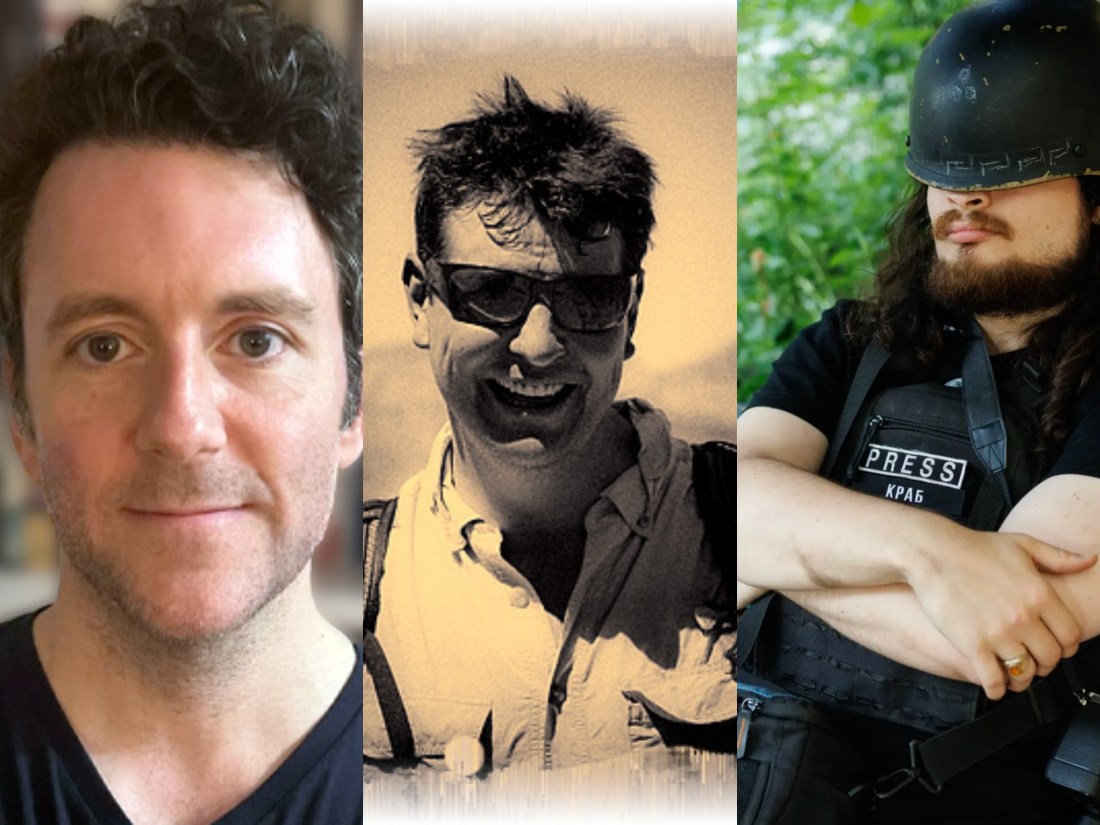
This isn’t a show of unity but a photo montage from La Stampa: (left to right) Mikhail Khodorkovsky, Garry Kasparov, and Vladimir Kara-Murza all lay claim to leadership of the Russian opposition in exile and the Russian antiwar movement.
Vladimir Kara-Murza has resigned from the [Russian] Antiwar Committee after Garry Kasparov’s offensive outburst in Paris.
I was there when it happened.
What happened, exactly?
At a dinner before a morning meeting with the leadership of the Parliamentary Assembly of the Council of Europe (PACE), Kasparov adopted a mobsterish tone with Kara-Murza, demanding to know why he would not sign the Berlin Declaration. Kara-Murza tried to respond constructively, explaining that he had been in prison when the Berlin Declaration was drafted.
“Aren’t you ashamed to say that you only served two years in prison, when there is a man here who served ten years?” Kasparov said, (referring to [Mikhail] Khodorkovsky. — A.G.).
To which the retort was: “Are you speaking as someone who fled Russia in 2013? As far as we know, you have served five days in jail in your entire life.”
At that point, Garry Kimovich lost it and started yelling that all true militants against Putin’s regime had left [Russia] and were fighting for Ukraine, rather than serving time in prisons.
“Why aren’t you fighting for Ukraine yourself, instead of serving time in a restaurant in Paris?” I asked.
“Why aren’t you fighting?” the chess player blurted out.
“But you’re a man, aren’t you?”
“I’m sixty-two years old!”
***
“You scoundrel!” Kasparov shouted at Kara-Murza. “Who got you out of prison?! I got you out! You’re not signing the Berlin Declaration because you can’t say that Crimea belongs to Ukraine!”
FYI: In 2014, after Kasparov had already emigrated, Kara-Murza declared that Crimea was part of Ukraine during an [anti-war] march in Moscow.
***
But here is the most “brilliant” thing the future member of PACE’s Russian platform said:
“Kara-Murza has a British passport, he swore allegiance to the Queen! But I haven’t sworn allegiance to anyone. I have a Croatian passport… just for traveling.”
He’s a traveler all right.
Croatian, my ass.
This was how PACE’s Russian platform was assembled.
PACE has decided to create a Platform for Dialogue between the Assembly and Russian democratic forces in exile.
Participants in the platform – whose composition has yet to be decided, based on a set of criteria – would be able to hold two-way exchanges with the Assembly on issues of common concern. They would also be able to attend meetings of selected committees during part-sessions.
Unanimously approving a resolution based on a report by Eerik-Niiles Kross (Estonia, ALDE), the Assembly said participants in the platform would be “persons of the highest moral standing” who, among other conditions, all share Council of Europe values, unconditionally recognise Ukraine’s sovereignty, independence and territorial integrity, and are working towards “regime change” in Russia.
The parliamentarians said the new platform – among other things – would help to strengthen the capacity of Russian democratic forces to “bring about sustainable democratic change in Russia and help achieve a lasting and just peace in Ukraine, alongside ensuring the responsibility of Russian actors for the international crimes committed”.
The Assembly said it honours the commitment of “those Russian human rights defenders, democratic forces, free media, and independent civil society who oppose the totalitarian and neo-imperialistic Russian regime, fight for democracy, human rights and the rule of law, and support Ukraine, sometimes at the risk of their lives and freedom”.
However, unlike Belarusian democratic forces, “Russian democratic forces do not have a single, unified political structure”, the Assembly pointed out. It encouraged Russian groups and initiatives in exile to join forces to advocate for democratic change in Russia, expose the crimes of the Russian regime and support Ukrainians.
On 1 October 2025, the Parliamentary Assembly of the Council of Europe (PACE) adopted a resolution to establish a Platform for Dialogue with Russian Democratic Forces (RDF). The initiative is intended to provide a framework for exchanges on issues of shared interest. The decision has sparked some controversy, which appears likely to grow.
A “Legitimate Alternative” Without Legitimacy
According to the report presented by the PACE General Rapporteur on RDF, Eerik-Niiles Kross, the Platform is designed to facilitate the participation of Russian opposition representatives in the Assembly’s activities. Approved candidates will form a delegation, gain access to committee meetings, and be able to address them. Yet the nomination procedure remains vague: Russian opposition groups are expected to reach a “common decision” on who will attend PACE sessions and then submit a candidate list to the President of the Assembly. This process is supposed to be completed by early next year.
The report describes Russian democratic forces as “a legitimate alternative to Putin’s regime.” However, the basis for such legitimacy remains unclear. Unlike the Belarusian opposition, which can point to Sviatlana Tsikhanouskaya’s electoral mandate from the 2020 presidential race, Russian opposition figures lack any comparable representative legitimacy. Strictly speaking, they represent no one but themselves.
PACE further specifies which actors it considers part of these “democratic forces”: structures associated with Mikhail Khodorkovsky, Garry Kasparov’s Free Russia Forum, Vladimir Kara-Murza’s Free Russia Foundation, as well as unspecified “representatives of the peoples of Russia.” The Anti-Corruption Foundation (FBK), founded by Alexei Navalny, is also mentioned, but the report explicitly excludes it from the category of democratic forces. The reason given is that the FBK refused to sign the Berlin Declaration, defined by the rapporteur as a conditio sine qua non for cooperation with PACE. In response, FBK representatives reiterated their lack of interest in working with what they called a “talk shop for expressing concerns” and branded the report “rude and vile.”
Defining Democratic Credentials
However, it is not only about the FBK. Some influencers and activists who denounce Russia’s crimes in Ukraine refuse to sign the Berlin Declaration, viewing it not as a universal document, but rather as an act of swearing personal allegiance to Mikhail Khodorkovsky and his Anti-War Committee, which drafted it. Even human rights defenders who did sign the Declaration question why it, in particular, has come to serve as the benchmark of democratic credentials. They regard its inclusion among the criteria for assessing the democratic legitimacy of a potential member as “odd,” since the Berlin Declaration represents “a private statement by one particular segment of the Russian opposition.”
Indeed, it is worth recalling that eight months before the Berlin Declaration, Alexei Navalny’s “15 Points”—a set of principles to which a significant number of Russian political activists still profess commitment—were published. These points outline similar foundations: ending hostilities and withdrawing Russian troops from the occupied territories, compensating Ukraine for the damage caused by the war, condemning imperial policies, committing to a European path of development, as well as dismantling the Putin regime and transforming Russia into a political system that would make the usurpation of power impossible. At the same time, both documents contain elements that appear puzzling. Notably, neither the Berlin Declaration nor Navalny’s 15 Points frames the war in Ukraine as Russia’s war, and both remain silent on the future of captive nations in Russia.
But even if one sets aside the questions raised by Navalnists as to why the “15 Points” are not adopted as the criterion of democratic legitimacy, how will PACE respond if other Russian opposition groups come up with similar declarations of their own?
Ukraine: Scepticism and Restrained Acceptance
Unsurprisingly, initiatives to create platforms involving Russian opposition figures within international organisations are viewed with deep scepticism in Ukraine. Most prominent Russian émigré politicians do not take part in armed resistance against the Putin regime, prefer to shift all responsibility for the invasion onto Putin personally, reject the idea of dismantling the Russian empire, and instead lobby for easing sanctions against “regular Russians.” Increasingly, they blame the west—rather than themselves—for the failure of democratisation in Russia. Nearly four years into the war, the exiled Russian opposition has proven largely irrelevant to Ukraine’s struggle against the invasion.
These arguments were strongly echoed by members of the Ukrainian delegation during the debate. Seven deputies took the floor. None opposed the resolution outright, but all signalled their distrust of the Russian political figures present in the chamber, stressing that they do not view them as a genuine opposition to Putin. Dialogue, they insisted, should be held only with Russians fighting in the Ukrainian armed forces and with representatives of captive nations.
Another concern raised was the lack of clarity in the procedure for determining Russian participants. The Ukrainian delegation succeeded in nearly doubling the criteria for candidate selection, but the Assembly rejected amendments that would have formalised Ukraine’s role in approving the list. This gave the impression that there is no genuine consensus within PACE on the establishment of the Platform for Dialogue with the RDF. As a result, some Assembly members began to doubt the wisdom of the initiative, suggesting that consultations with Russian opposition figures remain at the informal level.
Still, indirect signs suggest that communication between the PACE’s leadership and the Ukrainian delegation had taken place before the resolution was put to a vote. Notably, Ukrainian deputies refrained from openly torpedoing the resolution and instead largely abstained from the vote. Such restraint likely reflected a compromise, which may include the following items. First, the right of Ukraine to nominate representatives of Russian volunteer battalions serving in the Ukrainian armed forces, such as the Russian Volunteer Corps, which has already expressed willingness to join the Platform. Second, a commitment by PACE to establish a separate forum for indigenous peoples and national minorities of Russia, with one-third of seats on the current Platform reserved for them until that forum is created. Third, indirect Ukrainian involvement in controlling the Platform’s activities, possibly through performance indicators such as “feedback from Ukrainian civil society.”
Risks of Division Within the Platform
The creation of the Platform seems to carry potential risks for PACE while offering few tangible benefits. One of the key objectives declared by the resolution’s initiators is to foster greater unity among the highly fragmented Russian anti-Putin forces. In practice, however, it may have the opposite effect—further deepening and cementing the existing divisions among Russian diaspora political groups.
Besides, the inclusion of a diverse array of groups engaged in mutually irreconcilable conflicts raises the question of whether PACE can manage the level of potential tensions within the Platform itself. Frictions are likely to emerge between Russians fighting in the Ukrainian armed forces and well-known dissidents espousing pacifist convictions. Similarly, some Russian émigré politicians—despite condemning imperial policies—still advocate the armed suppression of any hypothetical secession by the North Caucasus. Such a position is unlikely to resonate with representatives of oppressed peoples, who view supporters of continued Russian control over their territories as foes.
It is also unclear whether PACE has a contingency plan should Ukrainian criticism intensify amid internal conflicts within the Platform. Such a scenario could place the Assembly in a difficult position, straining relations with Ukraine, a country whose citizens are dying daily for their independence and the values that the Council of Europe stands for. Were that to happen, the Platform would be remembered alongside PACE’s scandalous decision to restore the credentials of the Russian delegation in 2019 and the leadership’s attempts to shield its disgraced president, Pedro Agramunt—further damaging the Assembly’s image in Ukraine.
Defending his resolution proposal during the debate, Eerik-Niiles Kross drew a parallel with the Soviet occupation, noting that the Estonian diaspora played a vital role by representing the idea of an independent Estonia. By analogy, he argued, Russian democratic forces could play a similar role today, potentially producing their own Willy Brandt or Konrad Adenauer. The comparison, however, is not entirely accurate. Estonian émigrés did not enjoy a formal platform within PACE, but they still managed to convey their message effectively and ultimately saw it realised. Besides, the case of Germany clearly shows that it is not the establishment of a dialogue platform in Strasbourg that increases the chances of Russian Brandts and Adenauers emerging, but Ukraine’s victory on the battlefield. So far, there is scant evidence that prominent Russian emigrants have contributed anything of tangible significance to this cause.
In this darkest hour, we declare our strategic goals – to stop the aggression against Ukraine and create a free, rule of law based, federal Russia. To do this, we consider it necessary to strengthen the coordination of our actions.
We declare our commitment to the following fundamental positions:
The war against Ukraine is criminal. Russian troops must be withdrawn from all occupied territories. The internationally recognized borders of Russia must be restored; war criminals must be brought to justice and the victims of aggression must be compensated.
Putin’s regime is illegitimate and criminal. Therefore, it must be liquidated. We see Russia as a country in which the individual freedoms and rights are guaranteed, in which the usurpation of state power is eliminated.
The implementation of imperial policy within Russia and abroad is unacceptable.
Political prisoners in Russia and prisoners of war must be released, forcibly displaced persons must be allowed to return home, and abducted Ukrainian children must be returned to Ukraine.
We express our solidarity with those Russians who, despite the brutal repressions, have the courage to speak up from anti-Putin and anti-war positions, and with those tens of millions who refuse to participate in the crimes of the Putin’s regime.
The signatories of the Declaration share the values of a democratic society, respectful communication, recognize human rights and freedoms, the principles of diversity and equal rights, rejection of discrimination.
The signatories refrain from public conflicts in the democratic and anti-war movements.
We call on the citizens of Russia to join this Declaration.
We commit to uphold this Declaration until our common strategic goals are achieved.
According to eyewitnesses who spoke to SOTA, the reason for Vladimir Kara-Murza’s departure from the “Anti-War Committee” today was an argument that took place in a restaurant where potential PACE delegation members were seated. The quarrel began with Garry Kasparov accusing Vladimir Kara-Murza of a lack of teamwork.
According to Kasparov, Kara-Murza deliberately brought Yulia Navalnaya and Ilya Yashin to meet the PACE President, bypassing the general meeting—despite neither of them having signed the Berlin Declaration, which implies support for Ukraine. It should be noted that the opposition will receive only 12 seats in PACE, 4 of which are allocated to “decolonizers.”
Alexandra Garmazhapova, who is close to “Free Russia” and heads the “Free Buryatia” foundation created under its protection, omitted the beginning of the conflict with “Free Russia” Vice-President Kara-Murza in her Facebook post.
According to the former journalist, “Kasparov started questioning Kara-Murza in a thuggish tone about why he had not signed the Berlin Declaration. Kara-Murza tried to respond constructively that he was in prison when work on the Berlin Declaration was underway.”
Meanwhile, Kara-Murza himself stated on X (formerly Twitter) today that he and his colleagues from “Free Russia” were allegedly ready to sign the declaration but did not explain why they have not done so yet.
Back in October, Kara-Murza had virtually refused to sign the declaration: “When the criterion for participation in the Russian democratic platform at PACE is signing a document that a significant number of people associate only with one specific political group—that, in my opinion, is a completely clear element of political manipulation, and it is strange, to say the least. Many colleagues feel the same way, including those who were here in Strasbourg last week at the PACE plenary session.”
The “political group” he referred to is the “Anti-War Committee,” which Kara-Murza only left today under the pretense of a conflict with Kasparov, who is only one of its participants.
Garmazhapova further reported that Kasparov accused Kara-Murza of having “only served two years” in prison, unlike Mikhail Khodorkovsky. Garmazhapova then intervened in the conflict on the side of her “Free Russia” colleague, asking why 62-year-old Kasparov is not on the front line but demands it of others.
It should be noted that Natalia Arno—head of “Free Russia”—and Ilya Yashin, who conducts his world tours with funds from this foundation, also joined the public conflict.
Arno stated that “G. Kasparov allowed monstrous insults directed at my colleague Vladimir Kara-Murza,” called it “dirty methods,” called Kara-Murza a hero, and Kasparov someone who fled Russia in 2013. Arno herself emigrated in 2012.
Ilya Yashin, on X, urged Kara-Murza to believe that “he is there for him.”
Thus, the conflict for leadership in PACE between Khodorkovsky and Kara-Murza, as Arno’s protégé, which SOTA previously wrote about, became public today: Kara-Murza’s self-removal from the “Anti-War Committee,” despite the formal conflict with Kasparov—who is only one of its members—only highlighted the brewing contradictions and “intrigues” that Kasparov had mentioned.
Federation Council Speaker Valentina Matviyenko has promised that the Soviet-era law criminalizing “social parasitism” would not be revived.
And yet, the politician argues that certain categories of unemployed people should at least make contributions to the compulsory medical insurance system. The Federation Council speaker spoke about this in an interview with Moskovsky Komsomolets:
I am talking about those unemployed people who drive Mercedes, have considerable hidden incomes, and yet do not pay taxes or make contributions to the compulsory medical insurance system. Or those, for example, who let their flats in downtown Moscow for 200,000 rubles a month [approx. 2,200 euros], but “on paper” claim that they rent it out for 10,000 rubles a month [approx. 110 euros]…. The tax service should identify such unscrupulous citizens and flush them out of the shadow economy and shadow incomes…. Workers, teachers, and doctors should not have to pay for young, healthy people who are under no obligation to society.
According to Matviyenko, forcing such citizens to be involved in the compulsory medical insurance system is fair because it is impossible to live in society and be free from it. She noted that teachers, doctors, workers, and others should not have to pay for healthy citizens without fixed employment.
This is not the first time Matviyenko has voiced the idea of collecting health insurance contributions from the unemployed: she has said that paying 45,000 rubles a year [approx. 500 euros] is quite affordable.
Surveys show that most Russians oppose a tax on social parasitism.
“Social parasitism” was a criminal offense in the USSR from 1961 to 1991. People who were unemployed without a valid reason could be sentenced to corrective labor, exile, or imprisonment. Citizens engaged in shadow private business were often prosecuted on this charge. The poet Joseph Brodsky was also convicted of “social parasitism.”
In 1964, when Joseph Brodsky was 24, he was brought to trial for “social parasitism.” In the view of the state, the young poet was a freeloader. His employment history was spotty at best: he was out of work for six months after losing his first factory job, and then for another four months after returning from a geological expedition. (Being a writer didn’t count as a job, and certainly not if you’d hardly published anything.) In response to the charge, Brodsky leveled a straightforward defense: he’d been thinking about stuff, and writing. But there was a new order to build, and if you weren’t actively contributing to society you were screwing it up.
Over the course of the trial he stated his case repeatedly, insistently, with a guilelessness that annoyed the officials:
BRODSKY: I did work during the intervals. I did just what I am doing now. I wrote poems. JUDGE: That is, you wrote your so-called poems? What was the purpose of your changing your place of work so often? BRODSKY: I began working when I was fifteen. I found it all interesting. I changed work because I wanted to learn as much as possible about life and about people. JUDGE: How were you useful to the motherland? BRODSKY: I wrote poems. That’s my work. I’m convinced … I believe that what I’ve written will be of use to people not only now, but also to future generations. A VOICE FROM THE PUBLIC: Listen to that! What an imagination! ANOTHER VOICE: He’s a poet. He has to think like that. JUDGE: That is, you think that your so-called poems are of use to people? BRODSKY: Why do you say my poems are “so-called” poems? JUDGE: We refer to your poems as “so-called” because we have no other impression of them.
Brodsky and the judge were (to put it mildly) talking past one another: Brodsky felt his calling had a value beyond political expediency, while the judge was tasked with reminding him that the state needn’t subsidize his hobby if he wasn’t going to say anything useful. But the incommensurability of these points of view runs much deeper than this one case.
“Yara Tychina, a young transgender woman and Astana resident, picketed on Vodno-Zelyoniy Boulevard next to the House of Ministries and the Parliament. Unfurling a handmade transgender flag, she demanded that the Senate, the Presidential Administration, and the President reject the ‘LGBT propaganda’ amendments. She was taken to the Yesilskoye District Precinct of the Astana Police. Further details are in the video.”
“[In which video Ms. Tychina says] Hello! I am Yara Tychina. I’m an ordinary citizen of Astana. I work in the coffeehouse [?] industry. I’m an openly trans women. I am protesting peacefully today because there are no other means to impact my country’s repressive policies. I don’t simply oppose this law. [It] violates my rights and freedoms, the rights and freedoms of my friends, my colleagues, the people in my life and, most importantly, my family, over half of whom are members of the LGBT minority community. I have carefully scrutinized this law and I can say truthfully that it has nothing whatsoever to do with ‘propaganda,’ since in black and white it says that any mention of LGBT—in a positive vein, in a neutral vein, it doesn’t matter which; in personal profiles, in personal conversations with people, it doesn’t matter where—is considered ‘propaganda.’ The fact that I’m an openly trans woman makes me a criminal, according to the new amendments. These amendments also don’t have anything whatsoever to do with ‘protecting children,’ since hundreds of Kazakhstani LGBT children, who had no way of influencing [who they are], will find themselves outlawed. They will be banned. They will be forbidden from talking about themselves on social media. They will be forbidden from gathering together in public or in private.
“[Ms. Tychina is interrupted by Astana police officers, who claim she is violating the law. She repeatedly states her willingness to go with them to the police station. She then continues.] I heartily and tearfully implore the Presidential Administration, the Senate, and the President of the Republic of Kazakhstan, Kassym-Jomart Tokayev, and the Constitutional Court, if that doesn’t work, to reject these amendments. Otherwise, hundreds of thousands, if not millions, of Kazakhstanis, will unavoidably suffer. With these amendments, you will bridge the gap between Kazakhstan and Russia, but you will also drive away all international investments and significantly harm Kazakhstan’s standing in the international arena. But first of all you will harm people. You will harm my family. I implore you to stop it. Thank you!
“[Responding to a reporter, who asks her name, Ms. Tychina says] My name is Yara Tychina. I’m in the coffeehouse [?] industry. I have a small business. I’m an ordinary [female] citizen. [Responding to a question about her flag, she says] It’s a transgender flag, the flag of my identity. It’s homemade. [To the police officers] Let’s go! Thank you! [A police officer explains to the press that Ms. Tychina has not been detained but has voluntarily agreed to go with them to the station.]“
Police in Kazakhstan’s capital detained a transgender activist for staging a solitary protest against pending legislation prohibiting so-called “LGBT propaganda.” Yara Tychyna held up a handmade transgender flag near government buildings in downtown Astana and called for the Senate and the presidential administration to reject changes to the law, which are designed to proscribe “propaganda of non-traditional relations,” a formulation broad enough that positive portrayals of same-sex relations could be treated as prohibited content. Lawmakers have been debating the measure since the lower house approved it in November. Officials insist the restrictions are framed as child-protection rules. Critics warn that the draft’s language is vague and that equating LGBT themes with harmful content risks legitimising discrimination.
On Wednesday, November 12, the [lower house of the] Parliament of Kazakhstan (Mäjilis) unanimously passed a law banning “LGBT propaganda” in the media and on the internet. Violators face fines, and in the case of repeat violations, up to ten days in jail.
“Endeavoring to protect children from information detrimental to their health and development, provisions have been made to restrict the dissemination of information promoting pedophilia and non-traditional sexual orientation in public spaces, as well as via the media, telecommunications networks, and online platforms,” the document states.
The changes will affect nine laws. Violations of the ban will be punishable by a fine of up to forty minimum calculation indices (in 2025, this amounted to 157,000 tenge, or approximately 260 euros, or 24,500 rubles), or up to ten days in jail.
Kazakhstan’s Deputy Minister of Culture Yevgeny Kochetov explained that materials containing “propaganda of non-traditional relationships” would have to be labeled “18+.” Content that violates the law would be blocked.
Kochetov added that the strictures currently apply primarily to those who distribute materials. If minors attend a screening of a film rated 18+, the cinema’s managers, not the parents, would face a fine, he explained.
“If, for example, [men] are holding hands in the park, this is not considered propaganda. These are their personal boundaries, and there are no questions here,” said one of the sponsors of the bill, MP Yelnur Beisenbayev.
The Mäjilis initially sought to ban “LGBT propaganda,” in April 2024, by amending the law “On Mass Media.” They later proposed criminalizing “LGBT propaganda” and equating it with incitement to ethnic, social, or religious hatred.
When MPs began discussing banning “LGBT propaganda,” a petition entitled “We oppose open and covert LGBT propaganda in the R[epublic of] K[azakhstan]” was posted on the website E-Petition.kz. It was the third petition in the country to gather the fifty thousand signatures required for consideration by the government.
The Ministry of Culture and Information decided to partly accede to the petitioners’ demands—when it came to strictures aimed at “protecting and shielding adolescents and children from the promotion and cultivation of sexual relations.”
Consequently, the ban was presented as an amendment to the draft law on archiving.
Traditional values
In recent months, Kazakhstan President Kassym-Jomart Tokayev has repeatedly spoken about the need to protect “traditional values.” The day before the Mäjilis passed the bill, and ahead of his visit to Moscow, Tokayev published an article in Rossiiskaya Gazeta in which he spoke about the friendship between the two countries.
“We are united by a common take on traditional values, similar views on the pressing issues of contemporary life, and cooperation in ensuring the welfare of [our two] brotherly peoples,” Tokayev wrote.
In Russia, the law banning “LGBT propaganda” among minors was first introduced in St. Petersburg in 2011, and then at the federal level in 2013. In 2023, the Russian authorities went so far as to declare the “international LGBT movement” extremist.
As of July 2025, Human Rights Watch had catalogued more than one hundred criminal indictments and convictions [in Russia] for involvement in the “international LGBT movement” or for displaying symbols which the authorities attribute to this movement.
Following Russia’s lead, “LGBT propaganda” was banned in Hungary in 2021, and in Georgia in 2024.
LGBTQ+ in Kazakhstan
Homosexuality was decriminalized in Kazakhstan de facto in 1997 and de jure in 1998. Since 2003, transgender people have been able to change their gender marker in official documents.
In 2021, the Williams Institute at UCLA School of Law ranked Kazakhstan 154th out of 175 countries in terms of public acceptance of LGBTQ+, below Uzbekistan, Russia, and Afghanistan.
The online platform Equaldex, which researches the rights of sexual minorities around the world, writes that “[a]ccording to recent survey data, there appears to be strong opposition to LGBTQ+ rights in Kazakhstan.”
Many human rights organizations have already criticized Kazakhstan’s ban on “LGBT propaganda.”
Human Rights Watch urged lawmakers to reject the bill. The NGO argues that the proposed amendments violate fundamental human rights and could make LGBTQ+ people in Kazakhstan more vulnerable.
The Kazakhstani organization Queer.kz commented on the Mäjilis’s passing the amendments banning “LGBT propaganda” as follows: “We continue to write letters! Our organization will continue to work together with our colleagues to defend human rights and freedom!”
Over the past four years of America’s modern anti-transgender panic, Missouri has been one of its chief laboratories. Each legislative session brings a flood of new proposals targeting transgender people—with each year opening with often more than a dozen bills—and 2026 is already shaping up to continue that pattern. In the first batch of early bills, lawmakers introduced 21 anti-LGBTQ+ measures, many escalating the state’s enforcement tactics beyond even last year’s cruelties. One stands out in particular: a bill that would ban “social transition” in schools—blocking teachers from using a student’s chosen name or pronouns, even with parental consent.
The bill, SB1085, filed by Senator Joe Nicola, states in its summary that it would prohibit “public school staff members from encouraging minor students in their ‘social transition,’” which the measure defines as engaging in any activity “with the goal of helping a student become perceived as a member of the opposite biological sex.” The text defines social transition broadly—“participating” in a student’s gender transition based on “details such as his or her name, appearance, or behavior”—and bars schools from taking part in any conduct that could contribute to a student “not being perceived and treated as a member of the student’s biological sex.”
The bill explicitly forbids all school staff and faculty from “the use of alternative pronouns or names for the minor student, either in school records or otherwise.” Notably, it contains no provision for parental consent—meaning the restrictions apply not only to unsupportive parents but also to parents who affirm their transgender children. The measure appears to single out trans students exclusively: nothing in its text bars name changes for any other reason unrelated to gender transition.
The bill marks the latest front in anti-transgender legislation: an effort not just to ban medical transition for trans youth, but to prohibit any form of transition at all, including social transition. Earlier this year, reporting out of Texas showed how a similar law led teachers to suddenly deadname students who had used their affirmed names for years without issue. Variations of this language have surfaced in several states, but Missouri’s proposal is among the most explicit and far-reaching attempts yet to regulate social transition in schools.
The ban on social transition—even with parental permission—underscores a shift in how anti-trans legislation is being sold to the public. For years, supporters of bathroom bans, sports bans, and “don’t say gay” policies framed their efforts as battles for “parental rights.” Increasingly, though, that language has fallen away as lawmakers move to strip supportive parents of any authority at all, mirroring the approach in medical transition bans that override parental consent entirely. Under Missouri’s proposal, parents would have no right to approve their child’s affirmed name or pronouns, and any teacher who honors a family’s wishes could face the loss of their license.
The social-transition ban is just one front in a broader offensive. Missouri lawmakers have already filed bills to outlaw public drag by defining it as prurient “male or female impersonation,” to strip Pride flags from public schools, and to roll back nondiscrimination protections for transgender people in housing, employment, and public accommodations. And more proposals are almost certain to follow. When the legislature gavels in on January 8, the real question for observers won’t be whether these bills appear—they already have—but which ones Republican leadership chooses to fast-track. That early movement will signal just how aggressive Missouri intends to be in advancing its anti-LGBTQ agenda this session.
On April 27, 2023, Kansas became the first state in the country to institute a statewide definition of sex. “A ‘female’ is an individual whose biological reproductive system is developed to produce ova,” the law declared, “and a ‘male’ is an individual whose biological reproductive system is developed to fertilize the ova of a female.” Since then dozens of state legislatures have introduced similar bills; sixteen have passed. In Indiana and Nebraska governors have issued executive orders to the same end. Each of these measures effectively strips transgender people of legal recognition.
The language of these policies usually distinguishes men from women by their reproductive capacity, which is assumed to be determined at birth or even at conception. Each statute mandates that its definitions of “sex,” “female,” and “male” be used whenever those words appear in any part of the state code. Some purport to be establishing a “women’s bill of rights,” as the titles of Kansas’s and Oklahoma’s bills suggest; Louisiana’s is titled “The Women’s Safety and Protection Act.” (On the other hand, the name of North Dakota’s bill—into which legislators slipped another term they wanted to define—captures the arbitrariness involved: “The Definition of Female, Male, Sex, and Scrap Metal Dealer.”)
This legislation is part of a broader onslaught. In the past few years Republican-controlled state legislatures have introduced thousands of bills targeting trans people, with measures to ban puberty blockers and hormones for trans youth, bar trans girls and women from sports, mandate that bathroom access be based on birth sex, outlaw drag performances, and more. So far more than two hundred of these laws have passed, with grave, often life-changing consequences for the trans residents of red states across the country.
Following the shooting that claimed the life of a National Guard member last Wednesday in Washington, the Trump administration has announced it will be halting all asylum decisions and paused issuing visas for people travelling on Afghan passports. The suspect in Wednesday’s shooting that killed Specialist Sarah Beckstrom, 20, and critically wounded Staff Sgt. Andrew Wolfe, 24, is Rahmanullah Lakanwal, a 29-year-old Afghan national who worked with the CIA during the Afghanistan War and had been living in the U.S. since 2021. He applied for asylum during the Biden administration under a program that resettled Afghans after the U.S. withdrawal from the country, and was granted it this year under President Trump.
As seen in our infographic, based on data released by the U.S. Department of Justice, Afghanistan was not one of the 10 most common countries of origin for people who received asylum in the U.S. in the fiscal year 2024. Only 508 Afghans were granted asylum in the country that year, while 61 were refused. By comparison, the U.S. granted asylum to 3,605 Russian nationals, making Russia the most common nationality to get asylum in the country during that time period. This was followed by China, with 2,998 Chinese nationals receiving asylum, and Venezuela, with 2,656 successful asylum applications.